
Current Events
New York City Public Schools Overrun With Violence Due To Mayor Slashing Funds For Safety Agents
New York City has slashed the authorized headcount of uniformed safety agents assigned to protect students and staff in 1,800 public schools, leaving them more vulnerable to neighborhood gangs, violence and crime, principals and elected officials warn. The $126 billion FY 2027 budget approved last week by Mayor Zohran Mamdani and the City Council eliminated 264 vacant School Safety Agent positions, cutting the workforce to roughly 3,800. That’s down from 5,000 before the pandemic.
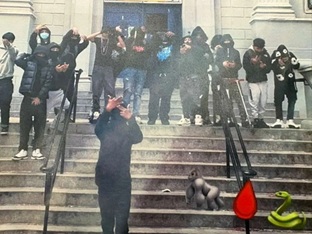
How does this make any sense, Mayor Mamdani?
Betsy Combier, Editor
'The Schools are Not Safe'
With gang-related crime rising, the loss of safety agents puts students and staff at risk, principals warn.
by Susan Edelman, July 7, 2026
https://susanedelman2.substack.com/p/the-schools-are-not-safe
New York City has slashed the authorized headcount of uniformed safety agents assigned to protect students and staff in 1,800 public schools, leaving them more vulnerable to neighborhood gangs, violence and crime, principals and elected officials warn.
The $126 billion FY 2027 budget approved last week by Mayor Zohran Mamdani and the City Council eliminated 264 vacant School Safety Agent positions, cutting the workforce to roughly 3,800. That’s down from 5,000 before the pandemic.
Uniformed but unarmed, school safety agents are hired and supervised by the NYPD. Their jobs entail keeping intruders out, scanning for weapons found on students, breaking up fights, patrolling halls, and monitoring dismissals. A shortage makes it difficult, if not impossible, to do it all, school leaders say.
The headcount reduction — meaning the vacant posts can’t be filled — goes “against the will of principals, teachers, students and parents” who consider the safety agents key members of their school communities, said Bronx Councilman Eric Dinowitz, chair of the education committee.
“I spent a lot of time talking to students across the five boroughs, and what I heard was consistent and urgent after the tragic murder of a young man in my district,” he said at a council hearing on public safety and education.
“They want to feel better protected in our schools,”
Dinowitz referred to Christopher Redding, 16, a student and budding football player at John F. Kennedy HS, an innocent bystander in a Feb. 11 gang shootout. Last week, Police Commissioner Jessica Tisch reported overall shootings down, but those committed by youths under age 18 rising to 22%, up from 19% last year.
At a recent hearing, Queens Councilman Phil Wong raised an alarming incident to underscore the danger. On April 24, eighteen masked teens in hoodies showed up at 1,700-student Grover Cleveland High School in Ridgewood, Queens, at about 4 p.m., with many students still in the building.
The teens, who spread out on the front steps and flashed gang signs, came from Brooklyn, officials said. A photo posted on Instagram shows symbols of the Bloods. They came looking for a student who belonged to a rival Queens street crew.
They wanted revenge. The Grover Cleveland student they sought “was involved in a gang robbery, and the victim brought these 18 kids over to look for him,” said Wong, who met with a local police commander to address the threat.
School staff quickly called the targeted student’s mother to pick him up. When a safety agent opened the front door, the youths scattered. The pack then walked to nearby middle schools IS 93 and IS 77, where they started fights, Wong said.
Gang members are visiting schools to recruit members and mark their territories, police tell school leaders.
A group of 14 youths showed up at Grover Cleveland again a few weeks later, this time during school hours, but left when confronted. Around the building, safety agents found bricks, rocks, and sticks believed carried as weapons.
As worried principals note, police have reported multiple incidents of teen gangs attacking and robbing high school students in Queens in the past year. In October, some 13 youths brutally kicked, punched and stabbed a 15-year-old boy near the intersection of 160th Street and Hillside Avenue as he walked home from school at 2:15 p.m.
" 'Give me all your clothes, whatever you're wearing, your shoes,' " the hospitalized victim told CBS News that an attacker demanded. "I starting running. After that, they pushed me and stabbed me." The assault left him with severe stab wounds and broken bones in need of several surgeries. NYPD reports no arrests.
Progressive educators and advocates hailed the Mamdani administration’s decision to lower the headcount of safety agents, saying it frees up funds for other efforts to resolve conflicts and prevent crime.
“Evidence-driven practices tell us that with the right investment in restorative justice and mental health, students have better academic outcomes than with over- policing,” said Kaliris Salas-Ramirez, a Rutgers University medical school professor and president of Community Education Council 4 in Manhattan, a parent advisory board.
But a safety agent shortage creates multiple headaches for principals. In many cases, when an agent calls out sick, it leaves schools unable to staff all the metal detectors used to screen students for guns, knives and other weapons in the morning – creating long lines for entry.
“I’ve had kids waiting 30 to 45 minutes to get into their school. That’s ridiculous,” said Michael Barakat, veteran principal of the Bronx High School for Law and Community Service, one of six small schools in the Theodore Roosevelt Educational Campus near Fordham University.
The campus uses three scanners to usher in some 2,500 students a day.
“When one of those scanners can’t be operated, it reduces our capacity by a third. And that’s why kids sometimes get into class up to a half-hour late,” Barakat said.
In a high-crime area, the schools have no choice, he said. “This is not about criminalizing kids. It’s about keeping kids safe.”
The campus, which takes up the huge block along heavily trafficked East Fordham Road, has five safety agents and a supervisor assigned. That’s not enough for teams of two to stand guard on all four corners at dismissal.
This spring, a street gang jumped a student outside the building in a case of mistaken identity. “He was badly hurt, but thank God made a full recovery,” Barakat said.
In another recent incident, a half-dozen youths in face masks and hoodies gathered across the street – during school hours —carrying mop or broom handles under black clothing.
“NYPD patrol called and told us to shelter in place because they were in pursuit of these guys,” Barakat said.
The NYPD can’t keep up with hiring enough school safety agents to replace those leaving for better-paying jobs. Agents, who include many women of color, make a starting annual salary of $36,955, increasing to $53,264 after five years.
“I’ve sent emails to more than one chancellor on this issue,” Barakat said. “It’s getting worse every year. We’re losing more and more agents every single year.”
Another principal said his school of more than 1,500 students has only one safety agent assigned. When that agent takes a break, goes to the local police precinct to voucher a weapon, or responds to a fight in the hall, the principal must ask a teacher or administrator to staff the front desk – or he does it himself. Multiple doorways in or out of the building and the exterior may go unmonitored, he said.
The principal’s message to Mayor Mamdani: “The schools are not safe.”
At the Council hearing, NYPD deputy chief Mary J. King, commander of the school safety division, and other police officials would not say whether the department follows a set ratio of students to agents. She insisted that mobile units fill in for absences and vacancies.
Councilman Dinowitz did not accept the NYPD’s assurances.
“It was clear they didn’t come prepared with information,” he told me. “And what they shared did not comport with the experience of anyone who’s been in a school building.”
Dinowitz met with Police Commissioner Tisch, who told him the NYPD has hired a new class of 100 safety agents, including some recruits as young as 18 and fresh out of high school to work as “assistant agents.”
Tisch promised the NYPD will aim to boost staff at schools with more than 1,000 kids, but only one safety agent.
“They’re going to make sure there’s at least two there. It’s not enough, but it’s better,” Dinowitz said.
In another NYPD-related move, Mamdani dropped plans to budget funds for 580 additional police officers for the Bronx. His 11th-hour backtrack “deeply disappointed” Council Speaker Julie Menin, who cited an increase in rapes, felony assaults, subway crime and hate crimes.
Editor, ADVOCATZ.com
Editor, ADVOCATZ blog
Editor, Parentadvocates.org
Editor, New York Court Corruption
Editor, NYC Rubber Room Reporter
Editor, NYC Public Voice
Editor, National Public Voice
Editor, Inside 3020-a Teacher Trials